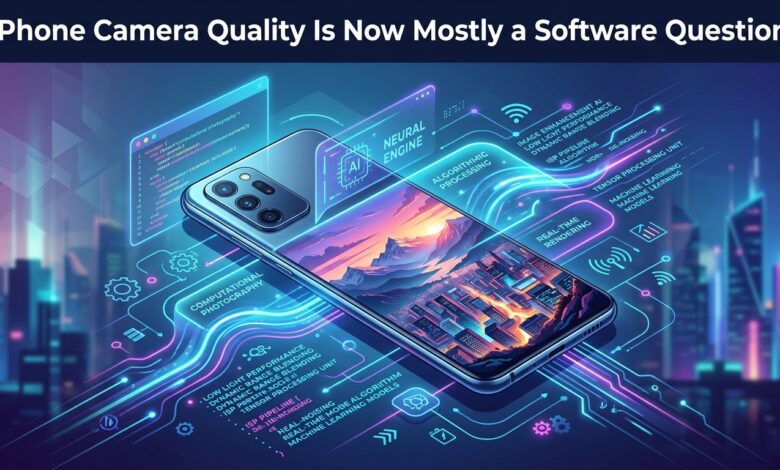
Key takeaway: A phone photograph is a computed estimate assembled from many frames. Sensor and lens set the ceiling; the processing pipeline determines how close the output gets to it.
What Happens When You Press the Button
You are not capturing one exposure. The phone has been buffering frames continuously, and the shutter press selects from that buffer plus frames captured immediately after.
The pipeline then aligns those frames — compensating for hand movement and subject motion — merges them to reduce noise and extend dynamic range, demosaics the sensor pattern, corrects lens distortion and vignetting, applies tone mapping, sharpens selectively by region, and adjusts colour.
Meanwhile, semantic segmentation identifies faces, sky, foliage and skin, and applies different treatment to each. Skies get saturation and gradient handling. Skin gets smoothing and specific colour targets. Foliage gets sharpening that would look wrong on a face.
This is why two phones sharing a sensor part number produce recognisably different images. The optics gathered similar photons; the software made different decisions about them.
The Genuine Physical Limits
Software cannot manufacture information the sensor never received.
| Constraint | Consequence |
|---|---|
| Sensor area | Total light gathered; noise floor |
| Pixel pitch | Per-pixel signal-to-noise |
| Aperture | Light throughput and depth of field |
| Optical focal length | Real perspective and compression |
| Optical stabilisation | Usable exposure length |
Sensor size is the most consequential and the least marketed. A larger sensor collects more light, which improves everything downstream — less noise, better colour, more shadow detail. This is why a large-sensor phone in dim light beats a small-sensor phone with more megapixels.
Optical zoom is the other unbridgeable gap. A dedicated telephoto lens captures genuine detail at distance. Digital zoom, however cleverly upscaled, is inventing plausible pixels. Recent AI upscaling produces impressive-looking results that are partly fabricated — fine for social sharing, unreliable when the detail matters.
Reading Specifications Sensibly
Megapixels above roughly 12 contribute little for normal viewing. High-count sensors typically bin pixels — combining four or nine into one — to improve light gathering, which means a 108 MP sensor usually outputs 12 MP anyway.
Look instead for sensor dimensions, maximum aperture, presence of optical stabilisation, and whether telephoto is genuinely optical. Then look at real sample images, because processing preference is subjective and no specification predicts it.
Working Around the Pipeline
Shooting RAW bypasses most processing and gives you the sensor data to interpret yourself. The trade is that you also lose multi-frame merging, so a single RAW frame is noisier than the computed JPEG. Some phones offer computational RAW, which keeps the merging while deferring tone and colour decisions.
For anything important, take several frames. The pipeline makes different choices frame to frame, and one will handle the scene better than the others.
The Bottom Line
Judge phone cameras by sensor size, aperture, stabilisation and real optical zoom range — then by sample images, since processing taste decides the rest. Megapixel counts and AI zoom claims are the least informative numbers on the specification sheet.