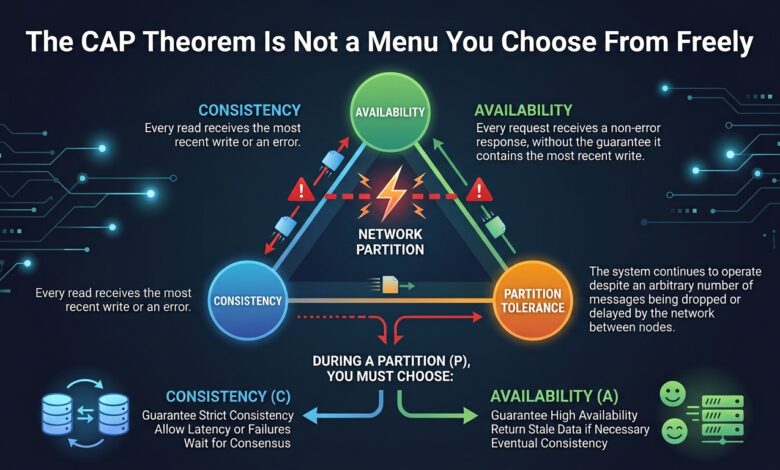
Key takeaway: Network partitions happen regardless of preference. The theorem describes what you must give up when one occurs, not a menu of three properties you get to pick two from at design time.
The Common Misreading
The CAP theorem is frequently summarised as “pick two of consistency, availability, partition tolerance,” which implies a real three-way choice. In practice, partitions occur whether or not a system is designed to tolerate them — a network link fails, a data centre loses connectivity, a process pauses long enough to look absent.
The actual choice is narrower and more useful: when a partition happens, does the system remain available and risk inconsistency, or does it preserve consistency and refuse some requests. Every distributed system with more than one node makes this choice, explicitly or by accident.
What the Trade-Off Looks Like in Practice
| System behaviour during a partition | Category | Example use |
|---|---|---|
| Reject writes until quorum is restored | Consistency-favouring | Financial ledgers, inventory counts |
| Accept writes on both sides, reconcile later | Availability-favouring | Shopping carts, social feeds |
| Reject reads that might be stale | Consistency-favouring | Configuration flags gating safety behaviour |
| Serve last-known value | Availability-favouring | Product catalogue display |
The right choice is not uniform across a system — it is per operation. A checkout flow might need strict consistency for inventory decrement while tolerating a stale product description on the same page. Treating the whole application as one CAP decision produces either unnecessary unavailability or unacceptable inconsistency somewhere it matters.
Where Reconciliation Becomes the Real Work
Choosing availability during a partition defers the hard problem rather than avoiding it. Two writes accepted on opposite sides of a partition must eventually be reconciled, and the reconciliation strategy is where the actual engineering difficulty lives.
Last-write-wins is simple and silently discards one of the concurrent writes, which is unacceptable when both writes carried real user intent. Conflict-free replicated data types provide mathematically sound merge semantics for specific data shapes — counters, sets, certain ordered structures — and do not generalise to arbitrary business logic. Application-level reconciliation, where the system detects a conflict and either merges domain-specifically or surfaces it to a human, is often the only correct answer for anything with real business meaning, and it is the most expensive to build.
Latency as the Practical Version of This Choice
Most teams encounter this trade-off not as a dramatic network partition but as ordinary latency. A read replica lags the primary by tens of milliseconds under normal load. Reading from it trades a small consistency risk for reduced load on the primary and lower read latency — the same fundamental choice, at a much smaller and more frequent scale than a true partition.
Recognising this framing is useful because it means the CAP trade-off is not a rare disaster-mode decision. It is made continuously, every time a read is routed to a replica, and the design should account for that frequency rather than treating consistency as free until an outage proves otherwise.
The Bottom Line
Decide consistency versus availability per operation based on what a stale or rejected result actually costs, rather than as one global architectural stance. Invest reconciliation effort proportional to how much a lost or merged write would matter, and recognise that ordinary replica lag is the same trade-off you would make during a genuine partition, just smaller and more frequent.