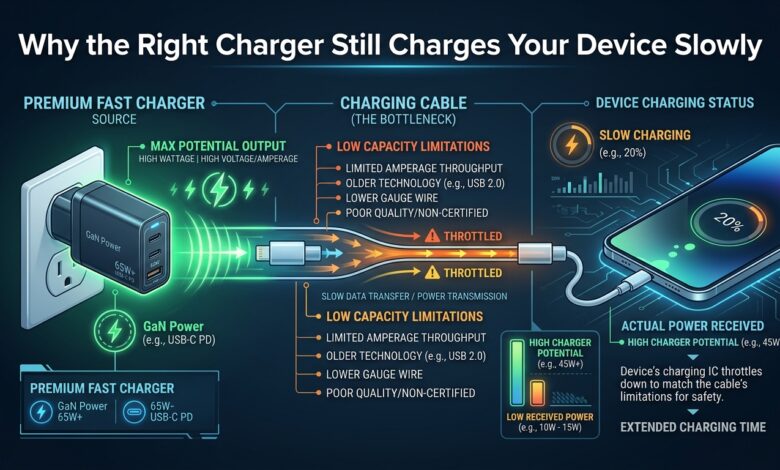
Key takeaway: A 100 W charger delivers 100 W only if the cable declares that capability and the device requests that profile. The slowest participant sets the speed, and nothing reports which one it was.
Three Parties Must Agree
USB Power Delivery is a negotiation, not a rating. When you connect a device, the charger advertises the power profiles it supports — combinations of voltage and current such as 5 V/3 A, 9 V/3 A, 15 V/3 A, 20 V/5 A. The device examines the list and requests one.
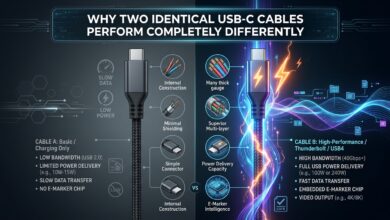
The cable participates too. Any cable carrying more than 3 A must contain an e-marker chip declaring its capability. A cable without one is treated as 3 A maximum regardless of its conductor gauge, which caps a 20 V connection at 60 W.
If any of the three does not support a profile, that profile is unavailable. There is no error and no notification — you simply get less power than you expected.
Where It Typically Goes Wrong
| Symptom | Likely cause |
|---|---|
| Caps at exactly 60 W | Cable lacks e-marker for 5 A |
| Caps at 15 W | Cable is USB 2.0 charge-only, or device declines higher profile |
| Fast then slow | Normal — charging tapers above ~80% state of charge |
| Slow only while in use | Device is sharing input power with active workload |
| Multi-port charger underdelivers | Total budget split across occupied ports |
The multi-port case surprises people most often. A charger labelled 100 W frequently means 100 W total. Plug in a second device and the first drops to 60 W or less, because the budget is reallocated. The label describes the power supply, not the per-port guarantee.
Battery chemistry accounts for another share of complaints. Lithium-ion cells accept high current only in the lower portion of their charge range. Above roughly eighty percent the charger switches to constant-voltage mode and current falls steadily. This is intentional — it protects cell longevity — and no cable or charger changes it.
Reading the Actual Numbers
Guessing is unnecessary. A USB-C inline power meter costs little and reports negotiated voltage and current directly, which immediately identifies whether the cap is 3 A (cable) or a voltage profile (charger or device).
Software works too: system_profiler SPPowerDataType on macOS and battery status in Windows settings both report the negotiated wattage.
Buying Sensibly
For laptop charging, buy a cable explicitly rated 100 W or 240 W — that rating is what indicates e-marker presence. Thunderbolt and USB4 cables always include one.
Prefer GaN chargers for size and efficiency, and check the per-port breakdown printed on the housing rather than the headline figure. A charger stating 65 W + 30 W simultaneous is more honest and more useful than one stating 100 W total.
Keep one known-good high-wattage cable and label it. Most charging mysteries resolve to a cable that looks identical to the good one and is not.
The Bottom Line
Charging speed is set by the least capable of charger, cable and device. Buy cables by wattage rating rather than appearance, read the simultaneous-use specification on multi-port chargers, and use a meter rather than guessing when something charges slowly.