Semantic Caching Catches the Repeat Questions Exact-Match Misses

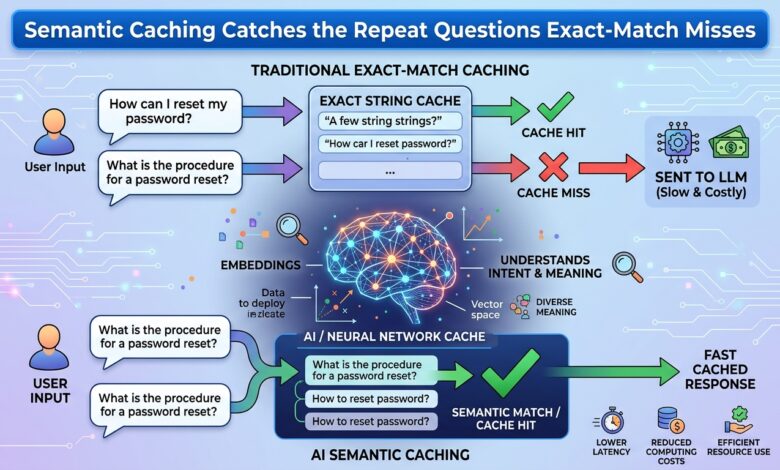
Key takeaway: A conventional cache matches exact strings. Semantic caching matches meaning, which is the form repeated questions actually take in real traffic.
Why String Caching Barely Helps
An exact-match cache keys on the literal request text. It works well for genuinely repeated calls — the same prompt template hitting the same document — and does almost nothing for user-facing chat, where the same underlying question arrives phrased ten different ways.
“How do I cancel my subscription” and “cancel subscription steps” and “I want to stop paying for this” are the same question to a user and three distinct cache misses to a string-keyed cache. In support and FAQ-style workloads, this gap is why exact-match caching delivers disappointing hit rates despite genuinely repetitive underlying traffic.
How Semantic Caching Works
The incoming query is embedded into a vector. A nearest-neighbour search against previously cached query vectors checks whether something sufficiently similar was already answered. Above a similarity threshold, the cached response is returned without calling the model at all.
| Layer | What it catches | Miss cost |
|---|---|---|
| Exact string cache | Identical repeated requests | Full model call |
| Semantic cache | Paraphrased repeated questions | Full model call |
| No caching | Nothing | Full model call every time |
The threshold is the parameter that determines whether this helps or actively hurts. Set too loosely, materially different questions get served the wrong cached answer, which is a worse failure than a cache miss because it looks like a correct response. Set too tightly, only near-duplicates match and the hit rate barely improves over exact-match.
Where the Threshold Actually Bites
Two questions that are lexically close and semantically opposite are the classic failure: “can I get a refund after 30 days” and “can I get a refund after 3 days” sit close together in embedding space and require a different answer. A similarity threshold alone cannot distinguish them reliably.
The practical mitigation is validating numeric and entity differences separately from the embedding similarity — extract dates, amounts and named entities from both the incoming query and the cached one, and require them to match before serving the cached response regardless of how high the embedding similarity scored. This catches the failure mode that pure vector similarity cannot.
What Belongs in the Cache and What Does Not
Cache answers to stable, factual questions — policy explanations, how-to steps, pricing tiers — where the correct answer does not depend on user-specific state. Do not cache anything referencing account-specific data, current session context, or content likely to change frequently, since a stale cached answer here is actively harmful rather than merely a missed optimisation.
Set a time-to-live appropriate to how often the underlying answer changes. A policy that updates quarterly can cache for weeks; a pricing page that changes with promotions needs a much shorter window or explicit invalidation tied to the content update.
Measuring Whether It Is Working
Track hit rate and, separately, false-positive rate — cases where a cached answer was returned and was wrong for the specific query. The second metric requires sampling and manual or automated review, and it is the one that determines whether the threshold is set safely rather than just efficiently.
The Bottom Line
Add semantic caching for stable, high-repetition questions, validate entities and numbers separately from embedding similarity to catch near-miss paraphrases, and measure false-positive rate alongside hit rate. A cache that saves cost while occasionally serving a wrong answer to a refund question is not a net improvement.