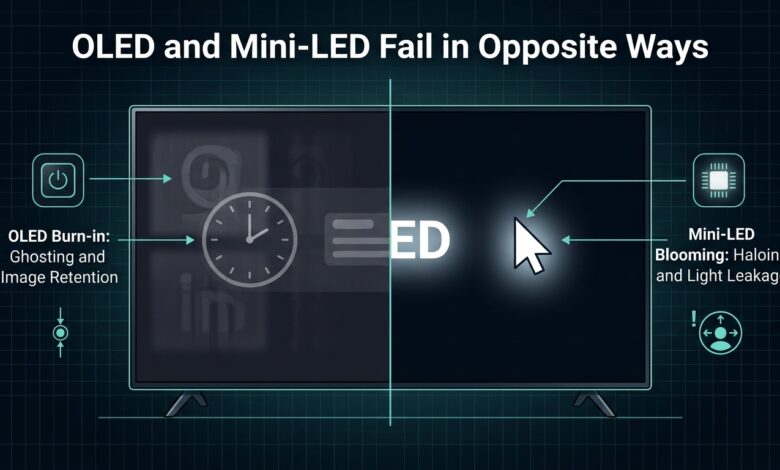
Key takeaway: OLED controls light per pixel; mini-LED controls it per zone. Every practical difference between them follows from that single architectural distinction.
The Underlying Mechanism
An OLED panel has a self-emitting element at every pixel. A black pixel is switched off, producing true black and effectively infinite contrast. There is no backlight to leak.
A mini-LED panel is an LCD with a backlight divided into hundreds or thousands of dimmable zones. Dark regions dim their zone, which improves contrast dramatically over conventional LCD but cannot reach zero while any pixel in that zone must stay lit.
Where Each One Shows Its Weakness
Mini-LED produces blooming: a bright object on a dark background lights its entire zone, creating a visible halo. White text on black is the worst case, which makes it particularly noticeable for anyone reading code or documents on a dark theme.
OLED risks burn-in: pixels age with use, and static elements — a taskbar, an editor sidebar, a persistent HUD — age faster than their surroundings, eventually leaving a faint permanent shadow. Modern panels mitigate this with pixel shifting, logo dimming and refresh cycles, and the risk with mixed content is low. The risk with the same interface displayed eight hours a day for years is not negligible.
| Property | OLED | Mini-LED |
|---|---|---|
| Black level | Perfect | Very good, zone-limited |
| Full-screen sustained brightness | Limited (250–350 nits) | High (600–1,500 nits) |
| Blooming | None | Present |
| Burn-in risk | Real with static content | None |
| Response time | Under 1 ms | 1–5 ms |
| Bright-room usability | Adequate | Better |
Sustained brightness is the specification most often misread. OLED peak figures apply to small highlights. A full white page — a document, a spreadsheet, a bright website — is much dimmer because total panel power is constrained. Mini-LED holds high brightness across the entire screen indefinitely.
Matching Technology to Use
Video and gaming in a controlled-light room: OLED. Per-pixel blacks and instant response are exactly what this content rewards, and varied imagery keeps burn-in risk low.
Office work in a bright room: mini-LED. Sustained full-screen brightness matters, static interface elements are constant, and blooming rarely appears in light-themed documents.
Programming on a dark theme: genuinely difficult. OLED renders it beautifully and faces the highest burn-in exposure. Mini-LED shows halos around every bright line of text. Many developers choose OLED and accept the risk; others use a light theme on mini-LED.
Photo and video editing: either, provided it is properly calibrated. Consistency and colour accuracy matter more than the panel technology.
The Bottom Line
Choose OLED for varied content in dim rooms where black level and response time dominate. Choose mini-LED for static interfaces, bright environments and all-day full-screen brightness. Both are excellent; they are excellent at different things.