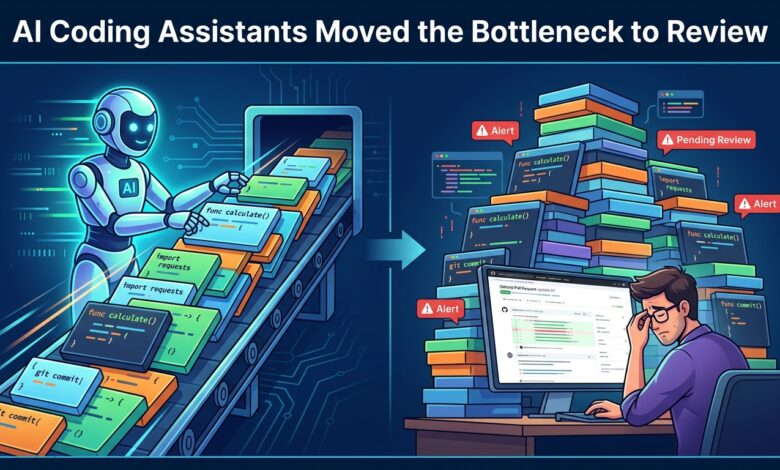
Key takeaway: AI assistants compressed the cost of writing code without touching the cost of understanding it. The constraint on delivery moved downstream, and most teams have not adjusted.
An Asymmetry Nobody Budgeted For
Writing a 200-line module used to take an experienced engineer two hours. With a capable assistant it takes twenty minutes. Reviewing that module thoughtfully still takes forty minutes, because reading unfamiliar code and reasoning about its failure modes is not a task the assistant made cheaper.
The result is predictable. Pull request volume rises, average PR size rises, and review latency rises faster than both. Queues form. Reviewers start skimming. Approval becomes a formality rather than a check.
What Skimmed Review Misses
AI-generated code fails differently from human code. It is rarely syntactically wrong and rarely obviously broken. It is plausible. The failure modes cluster in places a skim will not catch:
- Silent error swallowing — a
tryblock that logs and continues where the correct behaviour was to abort - Subtly wrong boundary conditions — off-by-one in pagination, inclusive versus exclusive range ends
- Invented API surface — calls to methods that do not exist on the version actually installed
- Duplicated logic — a helper reimplemented because the assistant had no visibility into the existing one
- Missing authorisation checks — the happy path is correct and the permission gate was never mentioned in the prompt
None of these produce a red build. All of them produce incidents.
Adjusting the Process
The teams handling this well changed review economics rather than exhorting people to try harder.
Cap diff size. A hard limit of roughly 400 changed lines per PR forces decomposition and keeps review within the window where attention holds. This constraint matters more now that generating a 2,000-line PR is trivially easy.
Require author annotation. The author states, in the description, which sections were AI-generated and what they verified. This is not about blame — it directs reviewer attention to where the risk concentrates.
Push verification left. Property-based tests, stricter type checking and static analysis catch the mechanical errors so human review can spend its budget on logic and design. Every check a machine performs is review capacity returned to a person.
Measure review latency explicitly. If time-to-first-review is climbing month over month, the pipeline is filling faster than it drains. That number predicts incident rate better than commit volume does.
The Uncomfortable Implication
Generation speed is no longer the constraint on how fast a team ships safely. Comprehension bandwidth is. Adding another assistant seat does not increase comprehension bandwidth — it consumes more of it.
The Bottom Line
Treat AI assistants as a change to your delivery pipeline, not a change to individual productivity. The bottleneck moved to review, and review scales with people and process rather than tokens. Teams that measure and manage review capacity will ship faster than teams that simply generate more.