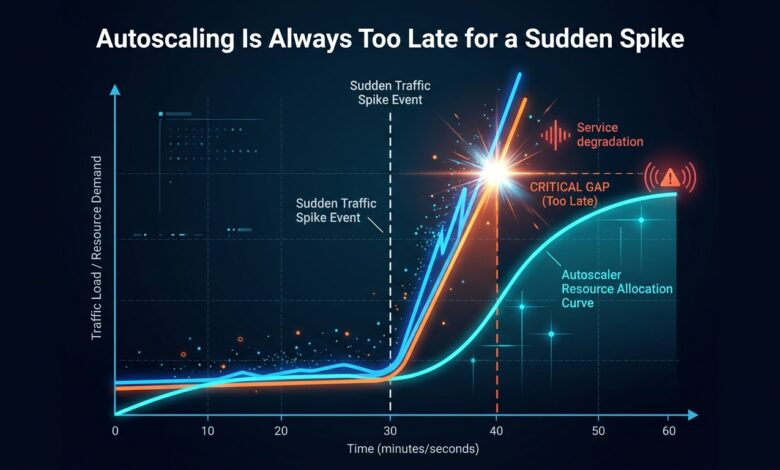
Key takeaway: Autoscaling is a cost-optimisation mechanism that reacts on a timescale of minutes. Treating it as a spike-protection mechanism guarantees an outage during your most important traffic event.
Adding Up the Delay
Every stage in the scaling loop contributes latency, and the total surprises people.
| Stage | Typical duration |
|---|---|
| Metric scrape and aggregation | 15–60 s |
| Scaling decision and stabilisation window | 15–60 s |
| Node provisioning (if needed) | 30–120 s |
| Image pull | 10–90 s |
| Container start and readiness | 5–60 s |
| Total | 75 s – 6 min |
A marketing email that lands at 09:00 delivers its traffic within thirty seconds. The additional capacity arrives after the spike has already saturated existing pods, filled queues and returned errors to the users who arrived first.
Worse, the metric that triggers scaling is often already distorted. If pods are saturated and requests are queueing, CPU may plateau rather than climb, and the autoscaler concludes nothing is wrong while latency degrades.
What To Do Instead
Scale on the right signal. Requests per second or queue depth lead CPU utilisation. Queue depth in particular reflects unserved demand directly rather than inferring it.
Pre-scale known events. Product launches, campaign sends and scheduled batch windows are all knowable in advance. A scheduled minimum replica count costs a few hours of extra capacity and removes the entire class of failure.
Keep warm headroom. Set minimum replicas so that normal traffic runs at sixty to seventy percent utilisation rather than ninety. The idle margin is the buffer that absorbs a spike while scaling catches up.
Pre-provision node capacity. A low-priority placeholder deployment that gets evicted when real pods need space eliminates node provisioning from the critical path, converting minutes into seconds.
Shed load gracefully. When saturation arrives faster than capacity, rejecting a small percentage quickly is far better than degrading for everyone. A queue that grows without bound turns a capacity problem into a total outage.
Tuning the Behaviour You Have
Asymmetric stabilisation windows matter more than most parameters. Scale up aggressively — a short window and a large step, because the cost of over-provisioning briefly is small. Scale down slowly, over five to ten minutes, because rapid scale-down immediately after a spike causes thrashing when a second wave arrives.
Startup time is the lever with the highest leverage and the least attention. A service that becomes ready in five seconds instead of ninety changes autoscaling from ineffective to genuinely useful. Pre-pulling images, trimming initialisation work and deferring non-essential warm-up all pay directly into scaling responsiveness.
The Bottom Line
Use autoscaling to track gradual demand curves and reduce idle spend. For known events, pre-scale on a schedule. For unknown spikes, rely on warm headroom and load shedding, because no autoscaler reacts fast enough to save you.