Key takeaway: Ask whether a device works with the internet unplugged. If the answer is no, you are buying a subscription to someone else’s server with hardware attached.
The Failure Mode Is Not Hypothetical
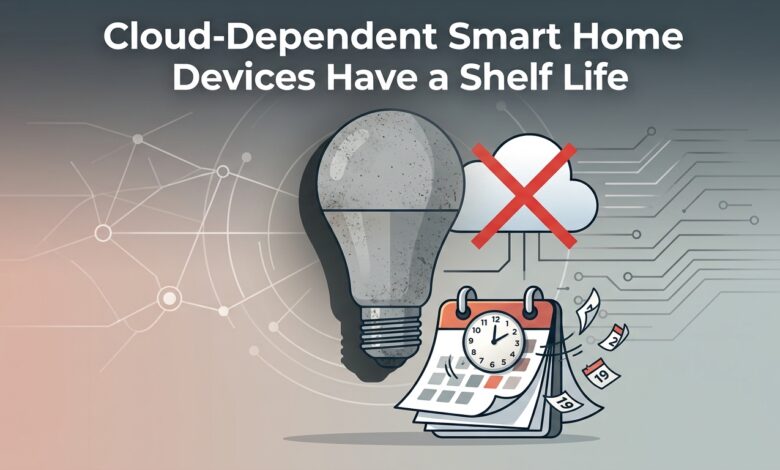
Numerous product lines have been discontinued with servers switched off, converting functioning hardware into inert plastic. Hubs, thermostats, cameras and lighting systems have all been affected. The devices did not break — the endpoint they depended on stopped answering.
Even while a vendor remains healthy, cloud dependency degrades daily use. Pressing a switch sends a request to a data centre, which relays it back to a device three metres away. That adds a few hundred milliseconds on a good connection, fails entirely when your broadband drops, and stops working during the vendor’s maintenance window.
Local Versus Cloud Execution
| Capability | Local control | Cloud control |
|---|---|---|
| Works during internet outage | Yes | No |
| Latency | 10–50 ms | 200–2,000 ms |
| Survives vendor shutdown | Yes | No |
| Remote access away from home | Needs setup | Built in |
| Privacy | Data stays local | Vendor holds it |
| Automation reliability | High | Depends on uplink |
Remote access is the one genuine advantage of cloud architecture, and it is achievable locally through a VPN or a self-hosted hub. That is more setup than a phone app, which is why vendors default to cloud — it is easier for them and easier for most buyers.
What To Check Before Buying
Does it speak a local protocol? Zigbee, Z-Wave, Thread and Matter-over-Thread all operate on a local mesh. Wi-Fi devices vary enormously — some expose a local API, others refuse to function without their server.
Is there a local API? Some Wi-Fi devices offer local HTTP or MQTT control. This is often undocumented and discoverable only through community forums, which is itself a signal about vendor priorities.
Does the automation run on the device or in the cloud? A motion-triggered light that evaluates its rule locally keeps working during an outage. One that reports motion to a server and waits for a command does not.
Is a subscription required for core function? Recording to local storage differs fundamentally from recording only to a plan you must keep paying for.
Matter improves the situation genuinely by standardising local control, though implementations vary and some certified devices still route features through vendor clouds.
The Practical Setup
A local hub — Home Assistant being the common choice — sitting between devices and any cloud service gives you local execution, one interface across vendors, and continued function when a vendor disappears. It requires real setup effort, and that effort is the price of a system that does not have an expiry date determined by someone else’s business decisions.
The Bottom Line
Prefer Zigbee, Z-Wave, Thread or Matter devices with documented local control, and run automations on local hardware. The test is simple: unplug your router and see what still responds.